Last updated November 18, 2026
The Complete Home Addition Contractor Guide for Paradise Homeowners
Most Paradise homeowners who stall mid-addition didn’t pick the wrong contractor. They picked a contractor before they understood what their address actually requires, and the two never matched. In Paradise, the trouble rarely starts on the job site. It starts with a jurisdiction question nobody answered, a heat spec written for a milder climate, or a bid that quietly left out three line items. This guide maps every checkpoint specific to Paradise so your family doesn’t lose months to preventable surprises, from permit jurisdiction to the wording of your warranty.
Quick Answer
Hiring a home addition contractor in Paradise, NV means navigating three layers at once: the right building jurisdiction for your specific address, desert-specific construction specs, and HOA rules that can override both. A written, line-item price document and a workmanship warranty that survives move-in are the two documents that protect you most. Get those, verify the license, and confirm jurisdiction before you sign anything.
Table of Contents
- Which Jurisdiction Governs Your Paradise Address?
- Why Desert Heat Changes the Spec Sheet
- What a Written Pre-Construction Price Must Include
- How to Read a Contractor’s License in Under Two Minutes
- Completion Guarantee vs. Workmanship Warranty
- HOA and Lot Rules That Override Everything
- The Addition Process, Step by Step
- What an Addition Costs in Paradise
Which Jurisdiction Governs Your Paradise Address?
This is the first checkpoint, and it’s the one most homeowners skip. Paradise is an unincorporated community in Clark County, but many addresses with a Paradise mailing label actually sit inside the City of Henderson’s planning boundary, and some sit inside Las Vegas city limits. The post office doesn’t decide building code. Your parcel’s jurisdiction does.
Here’s how to find out in a single afternoon:
- Pull your parcel number from the Clark County Assessor’s public records.
- Enter that parcel number into the county’s jurisdiction lookup or call the planning counter directly.
- Ask one specific question: “For this parcel, who issues the building permit for a room addition?”
- Write the answer, the date, and the name of the person who gave it on the top of your project folder.
Why it matters: Clark County and Henderson maintain separate submittal requirements, separate plan-review timelines, and separate inspection schedules. A contractor who’s excellent in one jurisdiction can be slow-footed in another simply because they’re unfamiliar with the checklist. Sign with someone who can tell you, without looking it up, which counter they’ll be standing at.
For a property that also involves converting an existing structure, see our Garage Conversion Contractor in Paradise guide, which walks through the same jurisdiction question for conversions.
Why Desert Heat Changes the Spec Sheet
Paradise summers push past 110°F, and the attic cavity above a new addition can hit 150°F or more. A general contractor who builds mostly in milder climates will underspec insulation almost every time, and you won’t feel the consequences until the first July electric bill.
The spec points to confirm on any Paradise addition design:
- Insulation R-values rated for Climate Zone 3 and confirmed in writing on the plan set, not just verbally.
- Roof tie-in details that account for thermal expansion where the new roof meets the old one. This joint is where the leaks show up in year two if it was drawn generically.
- Reflective or cool-roof material called out by name on the plans.
- HVAC load calculation run fresh for the combined square footage. Adding a room to an existing system without recalculating is how families end up with a room that never cools evenly.
We’ve seen additions in the neighborhoods around Flamingo Road and Eastern that developed ceiling cracks in their second summer because the roof connection was framed for a milder climate. The fix is inexpensive at framing time and expensive afterward. Ask your contractor what R-value they plan and why. If the answer is vague, that’s your signal. Prefab products from Dvele and Mighty Buildings already publish climate-rated specs, which makes verification easier on those builds.
What a Written Pre-Construction Price Must Include
Every family should receive a written price before a single tool is picked up. But a one-line total isn’t a price document. It’s a number. Here’s what a real one contains, and note the Home Addition Contractor in Paradise page if you want the shorter version of this checklist.
Line items most Paradise bids quietly leave out:
- Demolition and haul-off. Tear-out of an existing wall or patio cover and disposal of the debris. Often missing entirely.
- Permit fees and plan-review charges. Ask whether these are estimates or fixed, and who pays if review requires a second round.
- Final clean-up and landscape restoration. The soil, sod, or gravel disrupted by equipment and staging. Added as a change order at the end when it wasn’t quoted up front.
Beyond those three, the document should state allowances (flooring, fixtures, tile) with a dollar cap, and it should state what happens if you exceed the cap. Fixed pricing with no change orders after crews arrive is a legitimate thing to ask for, and it’s what our families receive on every project. Call (833) 856-4236 to schedule your free estimate and see a written price before any commitment.
How to Read a Contractor’s License in Under Two Minutes
Nevada makes this easy, and almost nobody uses it. The Nevada State Contractors Board runs a public license lookup that takes about two minutes to read properly.
- Go to the state board’s license search page.
- Search by the license number on the contractor’s paperwork, then search by company name separately. Both should return the same entity.
- Check the license status: it should read “active,” not “expired” or “suspended.”
- Check the classification. A residential addition requires the correct residential classification. A license for a different scope of work doesn’t cover your job.
- Look for any disciplinary actions listed. One old item with a resolved note reads differently than a current pattern.
Beyond the board site, a contractor is also expected to be licensed and insured as their state requires. Ask for a certificate of insurance showing general liability coverage and have your own agent glance at it. This costs you nothing and closes the single largest financial exposure on a project this size.
Completion Guarantee vs. Workmanship Warranty
These two phrases sound similar and protect you very differently. A completion guarantee says the contractor will finish the job. A workmanship warranty covers defects that appear after the job is done, when the crew is gone and the punch list is closed.
The second one is what you actually need, because the failures that matter show up later. A roof tie-in leak, a hairline crack at a drywall seam, a door that stops latching in its second summer. Those are workmanship issues, and only a written warranty that extends past move-in catches them.
Ask two questions before signing:
- “How long does your workmanship warranty run after final payment, and will you put that number in the contract?”
- “What exactly is excluded?”
Our families receive the 365-Day Done Right Promise in writing: if it isn’t done right, we make it right, across every addition and conversion. A warranty without an end date in the contract is marketing, not protection. Everything in this guide, from jurisdiction checks to the price document, exists so the finished project is one you can live in without chasing repairs.
HOA and Lot Rules That Override Everything
Here’s what surprises Paradise families most: your HOA can reject a project the county already approved. Many neighborhoods in Paradise operate under architectural review committees, and their approvals run on their own timeline entirely separate from plan review.
Sequence it correctly and you save weeks:
- Read your CC&Rs for architectural review requirements before you sketch anything.
- Confirm lot coverage and setback limits. Paradise lots vary widely, and a generous county setback doesn’t guarantee HOA approval.
- Submit your design to the HOA architectural committee early, in parallel with county plan review where allowed.
- Keep written records of every HOA response, including dates.
If the addition is really a second dwelling on your lot, the rules shift again. Our ADU Builders in Paradise guide covers the setback and sizing rules specific to accessory units. Either way, confirm the HOA picture before you sign a construction contract, because the contract won’t wait for a committee meeting.
The Addition Process, Step by Step
Once jurisdiction, specs, and HOA are settled, the physical process is straightforward. Here’s what a well-run Paradise addition looks like from your side of the front door.
- Design and engineering. Plans drawn, structural details confirmed for heat and roof tie-in.
- Jurisdiction submittal. Plans go to the correct counter for your parcel.
- HOA submittal runs alongside where the timeline allows.
- Permit issued. Work is scheduled only after permits are in hand.
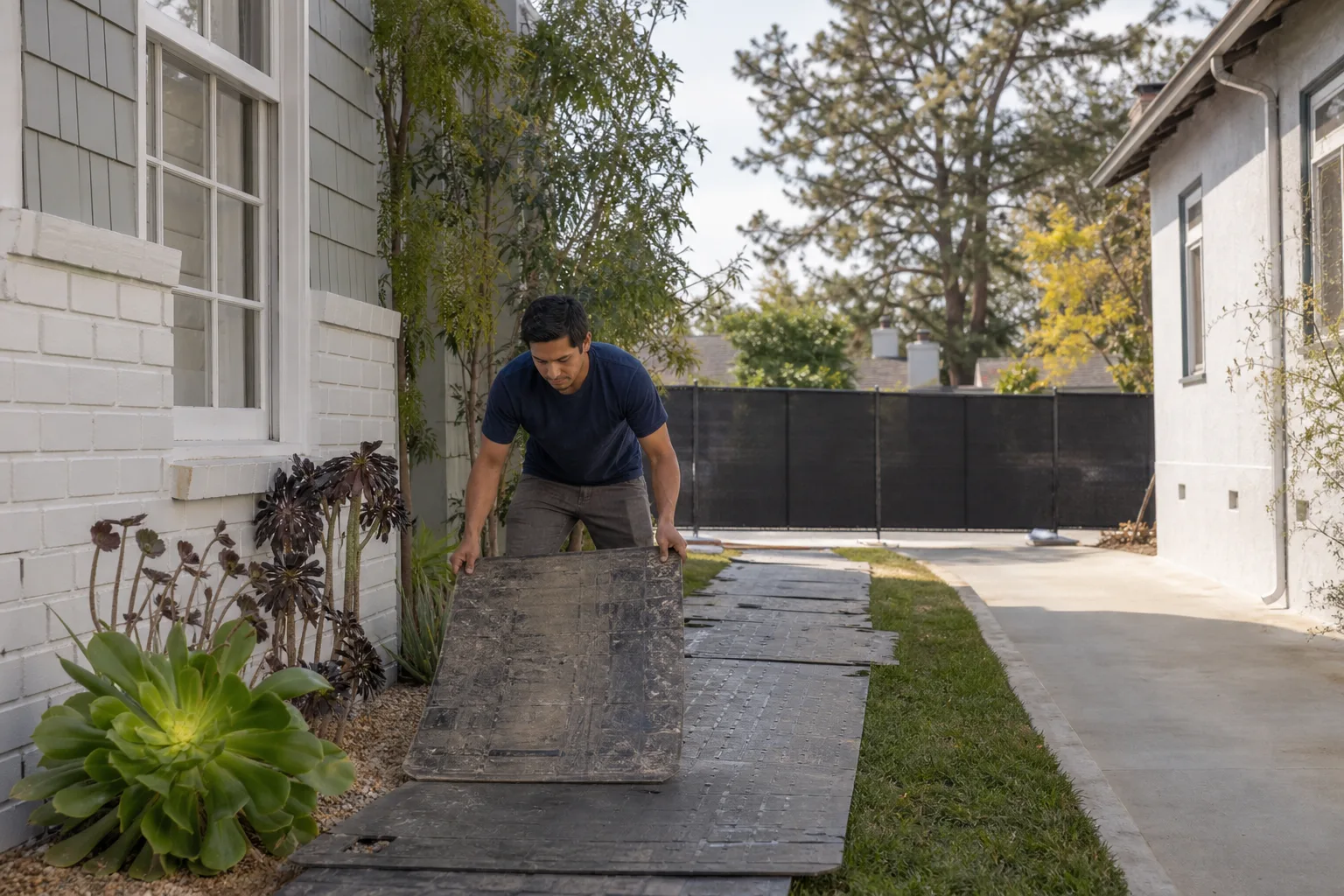
- Site protection. Floors covered, drop cloths laid, exterior staged so kids and pets stay out of the work zone.
- Framing and inspections on the jurisdiction’s schedule.
- Finishes and final inspection.
- Clean-up. A photo of the cleaned space taken before the crew leaves.
Inside the home, that means shoe covers and drop cloths on every visit, and pet-safe products wherever there’s a choice. When framing is happening near bedrooms, quiet tools and scheduling around school hours keep the household running. Our technicians have up to 25 years of experience, and every technician on your job is background-checked and uniformed, so you know who is walking through your door.
What an Addition Costs in Paradise
Use these ranges to plan your conversation, not as a quote. Your parcel, jurisdiction, and finish level all move the number.
- Design and engineering: $4,000 – $12,000
- Permit and plan-review fees: $2,500 – $9,000, depending on jurisdiction and square footage
- Room addition, standard finishes: $240 – $420 per square foot
- Room addition, high-end finishes: $450 – $650 per square foot
- Garage conversion (finished living space): $35,000 – $75,000
Written, upfront pricing is where the budget actually holds. On every project, our families receive the full price in writing before work starts, with no surprise line items added after crews arrive. Call (833) 856-4236 for an exact quote on your lot, and compare what our written price document includes against this guide’s checklist.
Common Mistakes to Avoid
- Signing before confirming jurisdiction. Two sentences on the phone with the planning counter can save you a rejected submittal and four weeks of waiting.
- Accepting a lump-sum bid. A single total line hides the demolition, permit, and clean-up exclusions that become change orders. Insist on line items.
- Copying a spec sheet from a milder climate. Insulation and roof tie-in details drawn for another region underspec for a Paradise summer.
- Skipping the license lookup. The state board’s site is public and fast, and it tells you the classification matches your job.
- Confusing a completion guarantee with a workmanship warranty. One gets the job done; the other covers the defects that surface after everyone leaves.
- Submitting to the county before the HOA. Architectural review runs on its own clock. Start both tracks early so neither one stalls the build.
- Not asking who walks through the door. Ask whether technicians are background-checked and uniformed. Families with kids and pets deserve the answer in writing.
When to Call a Professional
Call a professional before you sketch, not after. Any addition that touches structure, rooflines, or utility service needs a licensed contractor and a permit, and it isn’t a project to take on alone. If your plans involve relocating an exterior wall, changing a roofline, tying into an existing HVAC system, or adding square footage to a lot with setback questions, those are all signals to bring in a licensed contractor and confirm jurisdiction first. Electrical work in particular is genuinely dangerous. Panel work and new circuits require a licensed electrician, and we won’t walk you through doing it yourself. The same applies to any gas line connection for a new kitchen or laundry room. Get a professional. Seedling ADU Builders Paradise offers free estimates in Paradise. Call (833) 856-4236.
Frequently Asked Questions
It depends on the parcel, not the mailing address. Many Paradise addresses fall under Clark County, but some sit within Henderson or Las Vegas jurisdictions. Look up your parcel number through the Clark County Assessor and confirm with the planning counter before signing a contract.
A room addition in Paradise typically runs $240 – $420 per square foot for standard finishes, plus $4,000 – $12,000 for design and $2,500 – $9,000 for permits. Garage conversions generally run $35,000 – $75,000. Your exact number depends on jurisdiction and finishes, so call (833) 856-4236 for a written price.
It shouldn’t. A written line-item price with defined allowances is the standard to expect. Every project at Seedling ADU Builders Paradise receives a written price before any work begins, with no surprise line items added after crews arrive. If a bid is a single total with allowances listed as “TBD,” ask for the detail before you sign.
Yes, permits are pulled in the correct jurisdiction for your parcel and inspections are scheduled as part of the project. Confirm on your contract which jurisdiction your permit is filed under. That line item is your proof the paperwork matches your address. Call (833) 856-4236 to schedule a free estimate and review the permit plan for your lot.
Plan on four to six months for a typical room addition, with design and permitting taking a meaningful share of that time. Jurisdiction plan review and HOA architectural review are usually the slowest stretches. Starting the HOA track in parallel with county review is the single best way to shorten the total.
That’s a fair question to ask any contractor, and the answer should be specific. Our crews wear shoe covers and lay drop cloths on every visit, use pet-safe products wherever there’s a choice, and take a photo of the clean-up before leaving. Technicians are background-checked and uniformed. Live people answer our calls 24/7 throughout the project, so you’re never stuck in a voicemail tree during an active build.
The Bottom Line
The reason Paradise additions go sideways is almost never the hammer. It’s the paperwork that came first. Confirm your jurisdiction, get a heat-appropriate spec, demand a line-item written price, verify the license on the state board’s site, and hold out for a workmanship warranty with an actual end date. Do those five things and the build is a construction project, not a gamble. For families who want a starting point, our Seedling ADU Builders Paradise home page shows what written pricing and a live phone line look like in practice. Call (833) 856-4236 for a free estimate, and we’ll walk your lot and your parcel number together before anyone picks up a tool.
Written by the team at Seedling ADU Builders Paradise.